
BMI is a measure of your weight compared to your height.
Height
-331434087186.svg)
undefined' undefined"
Weight
-540010760641.svg)
undefined
kgs
Body Mass Index
kg/m2
Normal
Healthy BMI Range
18.5 - 25 kg/m2
-376949725404.svg)
You fall under Normal Category
Tap to see BMI Classification list

Body Mass Index (BMI) is a popular tool used for health-related assessments across various healthcare centres. It is a measurement that incorporates a person’s body weight and height to calculate the total amount of body fat they have. Body Mass Index, alongside other tools, can assist health care providers in assessing an individual’s health-related risk factors and overall health condition. Its core calculation is based on the BMI formula, which involves dividing your weight (in kilograms) by the square of your height (in metres). Also, the BMI is one of the many tools that help healthcare providers classify weight type, which includes Underweight, Optimum Range, Overweight and Obesity (Class I, II and III). Even though it has some limitations, knowing and learning more about your BMI can help in leading a healthy lifestyle. To get a quick overview of your body mass index, make sure to use an online BMI calculator. You can find more details about body mass index, like BMI definition, its ideal range, calculation methods, reliability of the results, how to interpret the data, its relation with health insurance, etc., on this page.
-36318624301-360.webp?q=75)
BMI for Women
Some studies suggest that the average BMI value for women is slightly lower than men. While some studies have suggested that higher BMI cut offs for women like 32, 33 are normal. Therefore, it is suitable to follow the BMI range that’s common for both.
-799053160420-360.webp?q=75)
BMI for Men
An ideal BMI range which is considered normal is supposedly between 18.5 to 24.9 kg/m2. BMI below18.5 (approx) is considered underweight and anything between 24.9 to 30 (approx) is considered overweight.
What is BMI?

BMI Definition
Body Mass Index (BMI) is extensively used as an indicator of body fat content. Knowing only the weight is not adequate to determine if a person is on a healthy weight range.

Better Health with BMI
Suppose a tall and lean person might weigh more than a short and chubby individual. However, the former may enjoy better health as long as their weight is suitable for their height.

Height and Weight Correlation
BMI correlates a person’s weight and height, and calculates whether your weight is appropriate for your height. BMI calculator is the best way to find whether your weight falls in the normal range or not.
How does one calculate BMI?
Easy Calculation
BMI calculation is fairly easy. It can be done using a handheld calculator or with the help of online on websites and apps with body mass index calculators.
Quick Result
To get the result, simply divide your weight in kilograms by the square of your height in metres. Or fill your height and weight in an app or website and the BMI results will flash on your screen.
Calculation Formula
BMI can be calculated with the help of two methods:International System of Units (SI) - BMI = weight (kg) ÷ (height (m))^2Imperial System - BMI = weight (lb) ÷ (height (inches))^ 2 × 703.
Right Range
Any number below or above the normal range is a cause for concern, and people should consult their doctors regarding the same
BMI Scale
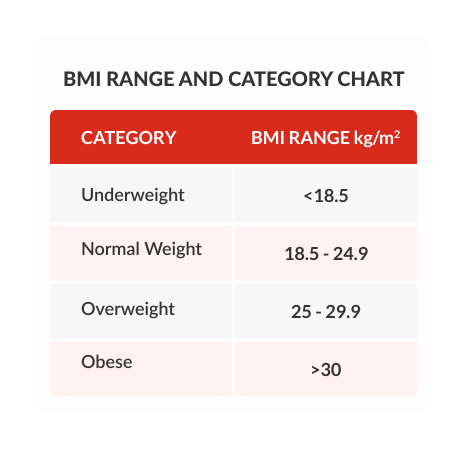
BMI scaling is usually as follows:
•Any number below 18.5: underweight
•Any number between18.5 to 24.9: normal
•Any number between 25 to 29.9: overweight
•Any number over 30: obese
-89360735431-1200.webp?q=75)


BMI Formula
To calculate your BMI value, you need to know your weight in kilograms and your height in metres. If you know what your height is in centimetres, you can simply divide that number by 100. To calculate your BMI, you need to divide your weight in kilograms by your height in metres squared.
BMI = mass (kg)/height^2 (m)
If you know what your weight is in pounds and what your height is in inches, the BMI can be calculated as well. You need to divide your weight in pounds by your height in inches squared. You then need to multiply the amount by 703.
BMI = 703 x [mass (lbs)/height^2 (in)]
Interpretation: For adults 20 years old and older, BMI is interpreted using standard weight status categories. These categories are the same for men and women of all body types and ages.


BMI for Kids
A child’s body develops and changes quickly. This is why a standard adult BMI chart will not be appropriate. Hence, to keep track of whether your child is the correct weight for their height, doctors use another chart. They start with a standard BMI calculation based on your child’s height and weight. The BMI value is then used to determine how your child compares to other children of the same age and gender. This is done with the help of percentages and percentiles. The weight categories for children, based on percentiles, are:
Underweight – BMI less than the 5th percentile
Normal Weight – BMI above the 5th percentile but lower than the 85th percentile
Overweight – BMI above the 85th percentile but lower than the 95th percentile
Obese – BMI greater than or equal to the 95th percentile
Interpretation: For children and teens, the interpretation of BMI depends upon age and sex.

What are the health risks for overweight people
Being overweight can lead to innumerable health complications, some of which can be critical as well. A higher body mass index is associated with increased risks for diseases such as:
Type 2 diabetes
High blood pressure
Heart conditions
Gall bladder-related complications
High triglycerides
Clinical depression and other mental health issues
Chances of stroke
Polycystic ovarian disease in women which may lead to reduced fertility and other menstrual irregularities

What are the health risks for underweight people
Having a low BMI is also associated with health risks, such as the ones listed below:
Vitamin deficiencies
Malnutrition
Low immunity
Hormonal imbalances
Osteoporosis
Disruptions in women’s menstrual cycle causing complications in conception

-64842246998-360.webp?q=75)
The high cost of medical care and increase in the number of diseases and health issues has made it absolutely essential for people to get a health insurance policy. Health insurance policies help people take care of their huge medical bills and in getting the best possible treatment. Body mass index is a requirement in health insurance.
-767278656130-360.webp?q=75)
BMI calculations do play an important role when purchasing health insurance. If your weight is closer to the healthy range, the fitter you are, and, hence, you have to pay lesser premium.
-604053878704-360.webp?q=75)
Health insurance premium amount is based on various factors. While there are a range of factors considered, some research show has indicated that overweight people often end up paying higher premiums for their health insurance policies.
-628540657558-360.webp?q=75)
A reason why overweight or obese people pay more health insurance is due to the fact that obesity is linked to be the cause of many other diseases such as diabetes, hypertension, etc. Insurers also assume the life span of obese people to be shorter –a factor that they keep in mind while calculating the premium amount.
-297012443468-360.webp?q=75)
People who are overweight, but not obese also have to pay an increased rate of premium. So, one of the ways you can lessen your health insurance premium is by choosing to lead a healthier lifestyle
HDFC ERGO offers a wide range of health insurance plans customized and designed to cater to the insurance needs of different sections of people. From having nearly 16,000 plus network hospitals to cashless claim service, check out the innumerable benefits provided by HDFC ERGO health insurance policies here

For adults 20 years old and older, BMI is interpreted using standard weight status categories. These categories are the same for men and women of all body types and ages.
-685018229308-360.webp?q=75)
For children and teens, the interpretation of BMI depends upon age and sex.
How reliable is BMI measure
BMI as a single measure may not be the perfect measure of health. However, it is still a useful starting tool which can be used to determine important conditions that can more likely affect a person who is overweight or obese. It is important that a person is aware about their BMI. Many medical professionals also use it as a basis for health checkups.
Health insurance companies also use it as a measure to determine the premium rates. But more importantly it is an indicator for you to maintain a healthy lifestyle. The Covid-19 pandemic has made us realise how vital it is to be fit and healthy. Hence, knowing your BMI is just a step forward to being aware of your health.
BMI also helps you to take necessary steps to improve your health. If you are overweight, you can take measures to reduce your weight by exercising, following a proper diet etc. Similarly, if you are underweight according to BMI, you can consult your doctor about how to increase your weight following a healthy protocol. Along with BMI, one needs to understand body composition. It describes the amount of fat, bone, water, and muscle in the body. So, to attain a healthy weight range, one has to aware of body mass composition as well.
Also Read : Demystifying BMI: Body Mass Index
BMI as a single measure may not be the perfect measure of health. However, it is still a useful starting tool which can be used to determine important conditions that can more likely affect a person who is overweight or obese. It is important that a person is aware about their BMI. Many medical professionals also use it as a basis for health checkups.
Health insurance companies also use it as a measure to determine the premium rates. But more importantly it is an indicator for you to maintain a healthy lifestyle. The Covid-19 pandemic has made us realise how vital it is to be fit and healthy. Hence, knowing your BMI is just a step forward to being aware of your health.
BMI also helps you to take necessary steps to improve your health. If you are overweight, you can take measures to reduce your weight by exercising, following a proper diet etc. Similarly, if you are underweight according to BMI, you can consult your doctor about how to increase your weight following a healthy protocol. Along with BMI, one needs to understand body composition. It describes the amount of fat, bone, water, and muscle in the body. So, to attain a healthy weight range, one has to aware of body mass composition as well.
Also Read : Demystifying BMI: Body Mass Index
BMI values do have certain shortcomings when it comes to predicting future health issues. It only uses your height and weight and it does not take your body composition into account. So, the distribution of your muscle and bone mass might increase your BMI even if you’re healthy and not likely to suffer from weight-related health issues in the near future. Here are some of the limitations of using BMI for various age groups:
Adults
BMI is not accurate since it only measures excess body weight instead of excess body fat. So, it’s a good idea for adults to use BMI along with other measures to understand their potential health risks. The drawbacks of using BMI for adults include:
• Older adults will likely have more fat than younger individuals who have the same BMI.
• Women are more likely to have more body fat than men who have an equivalent BMI.
• Athletes and muscular people will probably have a higher BMI than others since they have large muscle mass.

Young Adults and Children
BMI cannot take into account a child’s growth rate and maturity. It can be used to identify obese children, but not overweight children as a slightly higher BMI could be caused by increased fat-free mass.
Disclaimer: This blog provides general information and discussions about health and related subjects. The information and other content provided in this blog, website or in any linked materials are not intended and should not be considered, or used as a substitute for, medical advice, diagnosis or treatment. Kindly contact your Doctor before starting a new medicine or health regime.

What people were most curious about
How do I calculate my BMI?
BMI or body mass index is calculated according to an individual’s weight and height. It is calculated by simply dividing your weight in kilograms by your height squared in metres. You can also find the results instantly by entering the height and weight data in HDFC ERGO’s BMI calculator.
What is the importance of BMI to understand a person’s health condition?
BMI helps to understand whether you fall in the healthy or unhealthy category and accordingly if you require any treatment or not. It helps you to keep a check on your health.
In India, do insurance companies ask for BMI?
Yes. Most insurers in India take into consideration an individual’s BMI to determine the premiums charged on health insurance and term insurance plans. A person with a high BMI is assumed to be a high-risk applicant and is charged higher premiums. People with a healthy BMI are charged relatively low premiums. Thus it is important that you keep tabs on your health by using a BMI calculator frequently.
Can one solely depend on BMI to determine if they need to loose or gain weight?
Knowing and checking your BMI regularly and working towards the ideal body weight ratio may help in your fitness journey. However, there are other factors that one needs to consider when we talk about body weight such as genetics, level of physical activity, age and sex, etc. Also, BMI cannot be applied, for instance, to athletes, pregnant women, elderly or young children. This is because the body mass index does not consider whether the weight is carried as muscle or fat. So, before you arrive at a conclusion, remember reaching a healthy weight isn't just about reaching a certain number on the scale or a certain BMI. Following healthy eating and exercise habits is very important and it is always better to seek a doctor’s opinion before you proceed to attain your ideal bodyweight.

2023, 2024
2023, 2024
2023
2024
2024
2023, 2024
2023, 2024
2023
2024
2024
2023, 2024
2023, 2024
2023
2024
2024


-297114227466-360.webp?q=75)


